RV Classes Explained: Class A, B, C and Towables
Compare RV classes explained: Class A, B and C motorhomes, travel trailers, fifth wheels, truck campers and pop-ups. How each is built, towed and checked used.
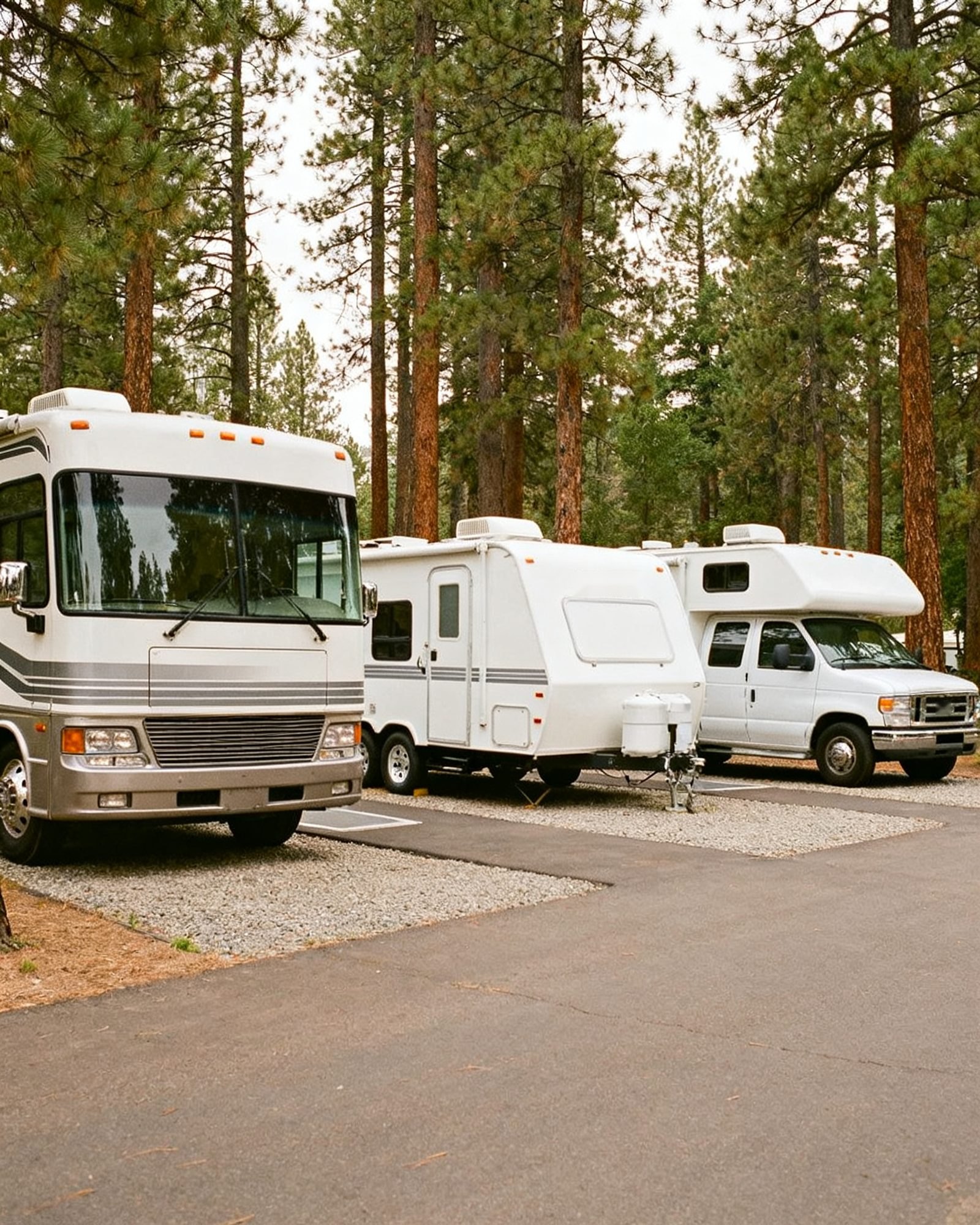
RV classes explained comes down to one split: a motorhome has its own engine and drivetrain, and a towable is pulled by a separate vehicle. Everything else — Class A, B or C, travel trailer, fifth wheel, truck camper, pop-up — is a variation on that split, and each variation changes how the unit is built, how you drive or tow it, what it weighs and what you check before buying used.
Every RV type in one table
| Type | How it is built | How it is driven or towed | Typical length | Who it suits |
|---|---|---|---|---|
| Class A motorhome | Box-shaped body with flat front and large windshield on a purpose-built motorhome chassis or commercial truck/bus chassis; gas engine usually front, diesel usually rear (diesel pusher) | Driven; driver and living area are one unit | Roughly 25 to 45 feet | Buyers who want the most living space and travel without a separate tow vehicle |
| Class C motorhome | Cutaway van or truck chassis with original cab kept and living body behind; most have a cabover bed or storage | Driven | Roughly 20 to 35 feet | Couples and families who want motorhome space in a smaller, easier-to-drive package |
| Super C | Heavier medium-duty truck chassis, often diesel; larger and heavier than a standard Class C | Driven | Larger and heavier than a Class C | Buyers who want truck-based durability and more weight capacity |
| Class B motorhome (camper van) | Built inside a full-size van body that keeps the van’s exterior shape, usually with a raised roof | Driven; parks like a van | Roughly 17 to 24 feet | Solo travelers and couples who want easy driving and parking; some have no bathroom |
| Class B+ | Marketing term, not an official class: small motorhome on a cutaway van chassis without a cabover bunk | Driven | Between a Class B and a Class C | Buyers who want a little more room than a van without a cabover |
| Travel trailer | Towable hitched to a ball mount on the tow vehicle’s receiver or bumper (bumper pull); single-axle small models up to large ones close to fifth-wheel size | Towed by a separate vehicle | Small to large | Buyers who want to unhitch and use the tow vehicle for daily driving |
| Fifth wheel | Raised front section rests over a pickup bed on a fifth-wheel hitch, so part of its weight sits over or just ahead of the truck’s rear axle | Towed; needs a pickup truck | Medium to very large | Buyers with a suitable pickup who want stable towing and tall living space |
| Toy hauler | Travel trailer, fifth wheel or motorhome with a rear ramp door and garage area for motorcycles, ATVs or gear | Driven or towed, depending on base type | Varies by base type | Buyers who bring motorized toys |
| Truck camper | Camper unit slides into a pickup bed and is held by tie-downs; can be removed so the truck is used alone | Carried in a pickup bed | Fits the truck bed | Buyers who want one vehicle for daily driving and camping |
| Folding (pop-up) camper | Light towable with canvas or hard sides that fold down for travel | Towed | Light and compact | Buyers with smaller tow vehicles who want simple, low-profile camping |
| Teardrop trailer | Very small towable, often only a bed inside and a kitchen under a rear hatch | Towed | Very small | Solo travelers and couples who want minimal setup |
| Hybrid (expandable) trailer | Hard body with fold-out tent beds | Towed | Travel-trailer range | Families who want more sleeping space in a lighter trailer |
| Park model RV | Built to stay at one site long term, not for regular travel | Moved to a site and left there | Varies | Buyers who want a seasonal site, not a traveling RV |
Motorhome against towable: the real trade-off
A motorhome is one vehicle to drive, insure, register and maintain. You can walk from the driver’s seat to the bathroom without stopping, and setup at a campsite is quick. The cost is that the drivetrain and the living area age together: engine and transmission service, chassis parts and house systems all come out of the same budget. When the motorhome is at the shop, your housing is at the shop. A motorhome that sits for long periods suffers from flat batteries, dried seals and stale fuel.
A towable separates the two. The trailer can stay at a campsite while the tow vehicle goes to the store, and the tow vehicle is serviced like any truck or SUV. The trade-off is that you need a properly rated tow vehicle, a correct hitch setup, and a place to store the trailer when it is not in use. Towing adds stress to the tow vehicle’s transmission, brakes and cooling system, and a poorly matched setup is dangerous. Weight ratings decide whether a towable is safe: the tow vehicle’s GCWR, GVWR, GAWR and payload must all cover the loaded trailer, passengers, cargo and hitch. The only way to know actual weight is a public scale, loaded, by axle where possible.
Running costs, in words: motorhomes tend to cost more to insure and maintain because there are two systems — chassis and coach — to keep up. Towables cost less to insure as a unit in many cases, but the tow vehicle carries its own costs, and trailer tires, brakes and bearings need regular attention. Neither is cheap; the question is which costs land on which vehicle.
Class A motorhomes: gas versus diesel pusher
A Class A is the largest motorhome class: a box-shaped body with a flat front and a large windshield, built on a purpose-built motorhome chassis or a commercial truck or bus chassis. Gas models usually have the engine at the front; diesel models usually have it at the rear and are called diesel pushers. Lengths run roughly 25 to 45 feet.
A gas Class A is usually cheaper to buy and to service, and more shops can work on it, though the front engine sits under a cover in the cab and some jobs are cramped. A diesel pusher typically gives more torque for climbing and towing, a quieter cab with the engine at the back, and often a heavier chassis — but its maintenance is more specialized and more expensive. On a used Class A, check the roof and all seams, the windshield for leaks, the slide-out seals and mechanism, the tires by DOT date, and the basement compartments for water stains. A diesel pusher needs a careful look at the cooling system, the air brake and suspension system where fitted, and engine records. For a deeper checklist, see used Class A motorhomes: gas vs diesel pushers.
Class C motorhomes: the cabover and the cutaway chassis
A Class C is built on a cutaway van or truck chassis, with the original cab kept and a living body behind it. Most have a bed or storage over the cab — the cabover. Lengths run roughly 20 to 35 feet. A Super C is built on a heavier medium-duty truck chassis, often with a diesel engine, and is larger and heavier.
The cabover is the classic Class C leak point. Water gets in at the front seam or the marker lights, runs down inside, and rots the bunk floor or the cab ceiling. Look for stains, soft spots and a musty smell, and use a moisture meter on the interior walls. The chassis cab also needs a mechanical check: front-end parts, brakes, and the condition of the tires. The living body is a second manufacturer’s product, so recalls can come from two makers. See used Class C motorhomes: who they suit and what to check for the full inspection list.
Class B camper vans: small, but not simple
A Class B is built inside a full-size van body that keeps the van’s exterior shape, usually with a raised roof. At roughly 17 to 24 feet, it is the smallest motorhome class. Many have a wet bath (shower and toilet in one compartment); some have no bathroom at all.
A camper van drives and parks like a van, which is its main advantage. The compromises are space, tank capacity and storage. On a used Class B, check the roof for aftermarket vents and solar mounts that may leak, the house battery condition and charging system, the water system for winter damage, and the van’s service history. Conversion quality varies widely; look at how wiring and plumbing are routed and fastened. See Class B RVs and camper vans: buying one used.
Travel trailers and fifth wheels: hitch and pin weight
A travel trailer hitches to a ball mount on the tow vehicle’s receiver or bumper. Tongue weight is commonly 10 to 15 percent of the loaded trailer weight. A fifth wheel has a raised front section that rests over the pickup bed on a fifth-wheel hitch, so part of its weight sits over or just ahead of the truck’s rear axle; pin weight is commonly 15 to 25 percent. A fifth wheel needs a pickup truck to tow it.
A weight-distributing hitch spreads tongue weight across the tow vehicle’s and trailer’s axles, and sway control resists trailer sway. Trailers with electric brakes need a brake controller in the tow vehicle, and many states require trailer brakes and a breakaway system above a weight they set — check your state DMV. Safety chains are crossed under the tongue. On a used towable, check the frame and hitch area for cracks, the axles and springs, the tires by DOT date, and every seam and roof penetration for water damage. Delamination — bubbles, waves or ripples in the sidewall — usually means water has got in. For a side-by-side, see used travel trailers vs fifth wheels.
Truck campers, pop-ups and toy haulers
A truck camper slides into a pickup bed and is held by tie-downs; it can be taken off so the truck is used on its own. The pickup’s payload on the tire and loading label must cover the camper’s loaded weight plus passengers and cargo. Tie-downs, turnbuckles and the camper’s floor pack are the parts to inspect. See truck campers: matching a used camper to your pickup.
A folding (pop-up) camper is a light towable whose canvas or hard sides fold down for travel. Check the canvas for tears and mildew, the lift system, and the roof for water damage. A teardrop trailer is a very small towable, often with only a bed inside and a kitchen under a rear hatch. A hybrid trailer has a hard body with fold-out tent beds; the tent ends and their seals are the leak points. A toy hauler is a travel trailer, fifth wheel or motorhome with a rear ramp door and a garage area; check the ramp springs, the garage floor and the weight of the toys against the cargo carrying capacity.
How to pick the type before you shop
Start with how you will use it, not with the floor plan. Answer these in order:
- Will you stay in one place for long periods, or move often? A towable suits long stays; a motorhome suits frequent moves.
- Do you have a vehicle that can tow, and what are its ratings? Check the payload label on the driver’s door jamb and the owner’s manual.
- How many people sleep in it, and do you need a bathroom? A Class B may not have one.
- Where will it be stored, and what is the height and length limit there?
- What is your realistic cargo and water load? Water weighs about 8.3 pounds per gallon, and propane about 4.2 pounds per gallon.
Only after those answers should you look at specific units. The type narrows the search; the inspection decides the purchase.
What goes wrong: red flags by type
Water damage is among the most common and most expensive defects in used RVs, and every type has its own weak points. On a Class C, the cabover seam. On a travel trailer or fifth wheel, the front and rear corners, slide-out seals and roof vents. On a Class A, the windshield seal and roof seams. On a truck camper, the tie-down points and the cabover floor. On a pop-up, the canvas and roof. A moisture meter on interior walls finds damp that cannot be seen.
Other red flags:
- Tires that are old by DOT code, whatever the tread. RV tires often age out before the tread wears out; common guidance is a yearly inspection once tires are 5 years old and replacement no later than 10 years from the date of manufacture.
- A title that does not match the seller’s ID, or a lien that has not been released. Check the VIN on the title, registration and federal certification label, and run an NMVTIS report and the NHTSA recall lookup.
- A price far below comparable RVs, a seller who cannot meet, or pressure to pay by wire or gift card before you see the RV and the title. That is the pattern the FTC and FBI warn about.
- A tow vehicle over any of its ratings, or with no margin left. A hitch, ball or receiver rated below the load is never acceptable.
- Propane or electrical work with no records. Propane leak testing, regulators, lines and appliances, and all 120-volt or 240-volt wiring, converter, inverter and generator work are jobs for a qualified RV technician.
- A branded title — salvage, rebuilt, flood or junk — which affects financing, insurance and resale.
An independent RV inspector, chosen and paid by the buyer, examines an RV before purchase; a lab analysis of engine oil, coolant and transmission fluid can be added on a motorhome. On any type, get the title and paperwork right before money changes hands.
Common questions
What is the difference between Class A, B and C motorhomes?
Class A is the largest, a box-shaped body on a purpose-built or commercial chassis, roughly 25 to 45 feet. Class C is built on a cutaway van or truck chassis with the original cab kept and usually a cabover bed, roughly 20 to 35 feet. Class B is a camper van built inside a full-size van body, roughly 17 to 24 feet.
Is a travel trailer or a motorhome cheaper to own?
It depends on which costs you already carry. A motorhome has chassis and coach systems to maintain and insure as one unit. A towable shifts drivetrain costs to the tow vehicle, which you may already own and service. Compare insurance, fuel, tires, brakes and storage for your situation, and check with your insurer.
Do I need a special license to drive a Class A motorhome?
The federal commercial driver's license does not apply to personal-use RVs, but some states require a special non-commercial license or endorsement for heavy motorhomes or long or heavy combinations. A GVWR over 26,000 pounds is a common threshold, but each state sets its own — check your state DMV.
What should I check on a used Class C motorhome?
The cabover seam and bunk floor for water stains and soft spots, the roof and all sealants, the slide-out seals, the tires by DOT date, and the chassis cab's mechanical condition. Because the living body and chassis can come from two makers, run the NHTSA recall lookup by VIN for both.
Can a half-ton pickup tow a fifth wheel?
Possibly, but only if the truck's payload, GCWR, GVWR and rear axle rating cover the fifth wheel's loaded pin weight plus passengers, cargo and the hitch. Pin weight is commonly 15 to 25 percent of the loaded trailer weight. Weigh the loaded setup at a public scale before trusting any brochure figure.
Read next
Used 4x4 Motorhomes and Off-Road Campers in the USA
Compare used 4x4 motorhome types: camper vans, 4x4 Class C, truck campers and expedition trucks. Learn what four-wheel drive adds and what to inspect.
Used Class B RVs and Camper Vans: What to Check
A practical guide to buying a used Class B RV or camper van: how they are built, who they suit, wet baths, tank sizes, home conversions and what to inspect.
Used Class C Motorhomes: Who They Suit and What to Check
How a used Class C motorhome is built, who it suits, how it drives, and what to inspect - especially the cabover, the classic spot for water leaks.