RV Campgrounds and Hookups: Full Hookup to Boondocking
Full hookup, partial hookup or no hookup at all: how RV campgrounds and public-land camping work, what each site gives you and how to pick one.
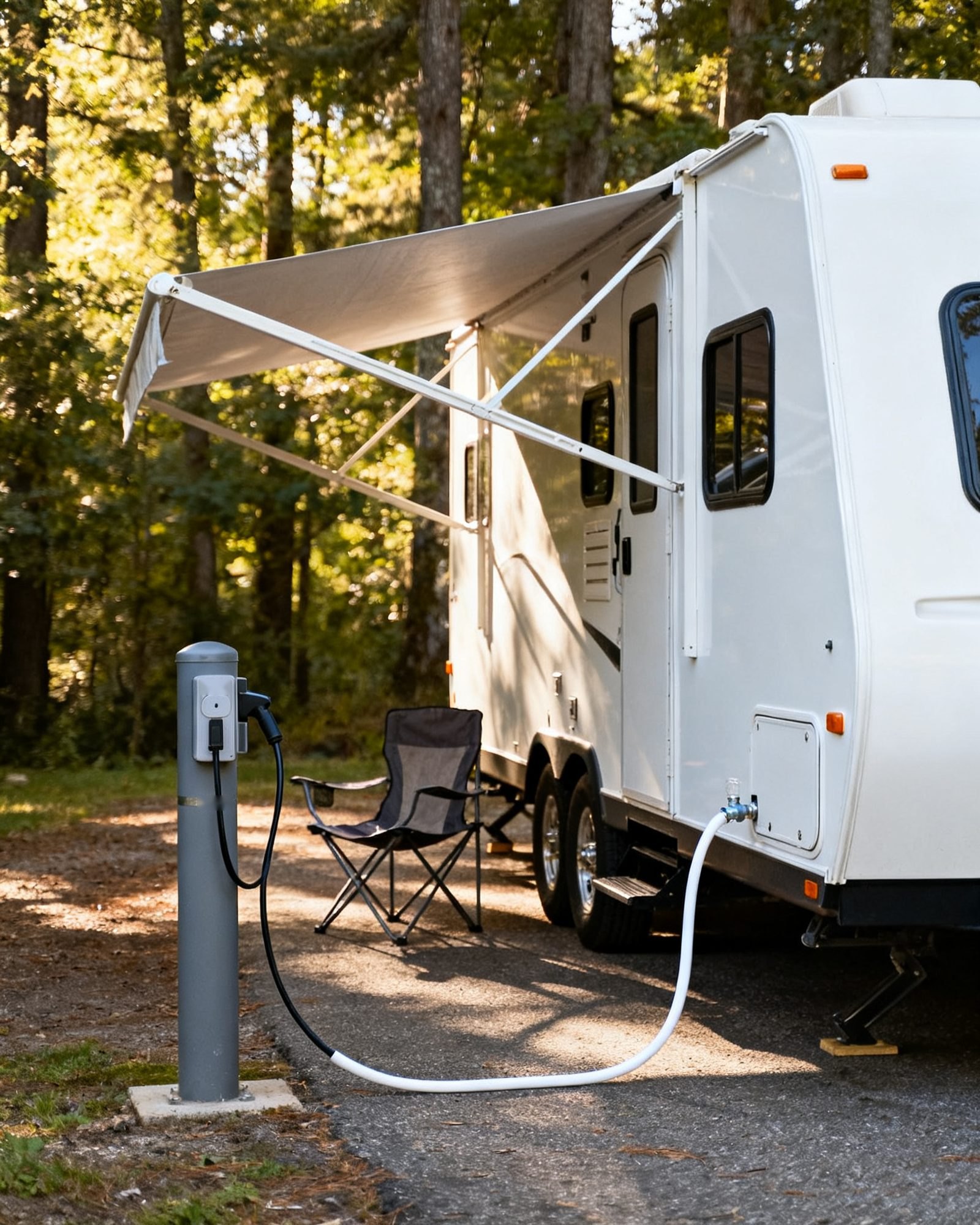
An RV campground is any place you park an RV overnight, and the sites come in three hookup levels: full hookup (water, electric and sewer at the site), partial hookup (some of those), and no hookup at all, which is dry camping or boondocking. What you can use at each level depends on the RV’s tanks, batteries and electrical system, so the site you book has to match the equipment you own. A used RV that has sat for a while needs its systems checked before the first night out, not after arrival.
The three hookup levels, and what each one gives you
| Site type | Water | Electric | Sewer | What it suits |
|---|---|---|---|---|
| Full hookup | Yes | Yes | Yes | Longer stays; heavy water and appliance use |
| Partial hookup | Some | Some | Usually no | Short stays; refilling and recharging |
| Dry camping / boondocking | No | No | No | Self-contained RVs with charged batteries and empty tanks |
Full hookup campsites are the simplest to use. You connect a drinking-water hose, plug in shore power and attach a sewer hose, and the RV behaves much like a small apartment. On full hookups, keep the black tank valve closed until the tank is mostly full, then dump black first and gray second, which rinses the hose. Leaving the black valve open lets solids pile up and the tank misbehave.
Partial hookups usually mean electric only, or electric and water. You fill the fresh tank from a spigot and watch the gray and black tanks, then dump at a station on the way out. Many public campgrounds offer nothing at all beyond a picnic table and a fire ring.
Private RV parks, public campgrounds and dispersed camping
Private RV parks (often called RV resorts) tend to have the widest sites, the most full hookups and the most amenities. They also tend to cost more and may have rules on RV age or condition, so read the park’s rules before booking a used rig.
Public campgrounds run by federal, state, county or municipal agencies usually sit on public land and offer simpler sites. Many older public campgrounds have sites too short for large RVs, so check the site length before booking, not the campground’s general description. Some have electric only, some have water only, and many have neither.
Dispersed camping means camping outside a developed campground on public land. On land managed by the Bureau of Land Management, dispersed camping is generally limited to 14 days within a 28-day period, unless local rules say otherwise. Other agencies set their own rules, and some areas close to dispersed camping entirely. Check the managing agency’s current rules for the specific area before you drive out.
Boondocking is the general term for camping with no hookups, whether on public land or in a parking spot someone allows. It puts the whole load on the RV’s batteries, propane and tanks.
What no-hookup camping asks of your RV
Without a pedestal, the coach battery system carries the 12-volt loads: lights, water pump, furnace fan and the control boards on appliances. The coach system is 12 volts DC, and two 6-volt batteries wired in series also make 12 volts. A converter charges the batteries and runs 12-volt systems from shore power; an inverter makes 120-volt AC from the batteries. Running a microwave or a coffee maker off an inverter drains batteries quickly, so plan those loads for generator time or a hookup day.
Lead-acid batteries (flooded and AGM) and lithium iron phosphate batteries need different charging profiles. Most lithium iron phosphate batteries must not be charged below freezing unless they have built-in heating. Flooded lead-acid batteries need their water level checked and topped up with distilled water. A used RV may arrive with batteries of unknown age and condition, so test them before relying on them. RV electrical basics: 30 amp vs 50 amp, batteries and generators explains the systems in more detail.
Water is the other limit. Three tanks do the work: fresh water, gray (sinks and shower) and black (toilet). Use a hose made for drinking water and a pressure regulator at campground taps. A water heater must be full of water before its electric element or burner is switched on. RV water systems: fresh, gray and black tanks covers filling, dumping and tank care.
Propane usually runs the furnace and the stove, and often the fridge and the water heater. Motorhomes usually have a permanently mounted ASME tank filled in place; trailers usually carry removable DOT cylinders, commonly two 20-pound or 30-pound cylinders on the tongue. Since 2002, DOT propane cylinders of 4 to 40 pounds must have an overfill prevention device (OPD) to be refilled, recognised by a triangle-shaped valve handwheel. A DOT cylinder must be requalified 12 years after its date of manufacture and at set intervals after that; an out-of-date cylinder should not be refilled. Any propane leak testing, regulator or line work is a job for a qualified RV technician.
Shore power: 30 amp, 50 amp and household outlets
Shore power comes in two common services. 30-amp service is 120 volts on a three-prong TT-30 plug, about 3,600 watts. 50-amp service is 120/240 volts on a four-prong 14-50 plug with two 50-amp legs, up to 12,000 watts. With an adapter an RV can use 15-amp and 20-amp household outlets, limited to that outlet’s capacity.
A 30-amp RV must never be connected to a household 240-volt outlet such as a dryer outlet. That mistake can destroy converters and appliances. Surge protectors and electrical management systems protect against faulty campground pedestals, and a used RV should carry one. Work on 120-volt or 240-volt wiring, the converter, inverter or generator is a job for a qualified RV technician.
Generator exhaust contains carbon monoxide: the CO alarm must work, and a generator must never run with its exhaust blocked (snow, walls, other vehicles) or near open windows. RVs carry smoke, carbon monoxide and LP gas alarms; test them and replace them by the date on the unit.
Site length, access and the height you must know
A listed site length is not always the usable pad length, and a rig that fits the pad may still not fit the driveway or the trees. Federal rules allow vehicles up to 102 inches (8.5 feet) wide on the National Network of highways, not counting mirrors and certain safety devices; height limits are set by the states. Know the RV’s exact height, including roof air conditioners and antennas, and keep it written where the driver can see it. The same number matters at campground entrances with low branches and at fuel stops.
Ask about the approach: narrow roads, tight turns and low clearance catch long RVs. A pull-through site is easier than a back-in for a first trip, and a back-in with a spotter is manageable once you have practiced.
Reservations, stay limits and campground etiquette
Popular public campgrounds fill early in peak season, and many take reservations through a booking system. Walk-up sites exist but are not something to count on with a long rig. Stay limits vary by park and agency; the 14-days-in-28 rule on BLM land is one example, and developed campgrounds often set shorter limits. Read the rules when you book.
Etiquette is mostly about other people’s space and quiet: keep generators off during quiet hours, do not run a generator near another site, keep pets leashed, and leave the site as found. Dump stations are shared, so be quick and clean. Do not dump gray water on the ground at a developed campground.
What goes wrong at campgrounds and hookup sites
The common failures are predictable:
- Pedestal problems. Reverse polarity, open grounds and worn outlets damage RV electronics. Use a surge protector or electrical management system and check the pedestal before plugging in.
- The 240-volt mistake. Plugging a 30-amp RV into a dryer outlet is a costly error; adapters do not make it safe.
- Black tank mismanagement. Leaving the black valve open on full hookups, or dumping black after gray, causes clogs and odors.
- Battery failure off grid. A used RV with weak batteries may run lights for an evening and then fail the furnace overnight.
- Water damage from a full tank. Overfilling the fresh tank or leaving a hose pressurized can find weak fittings.
- Site mismatch. Booking a site shorter than the RV, or a campground with a tight entrance, turns arrival into a problem.
- Propane and CO risks. A cylinder that is out of date, a leaking regulator or a blocked generator exhaust are safety issues; have a qualified RV technician check the system.
- Reservation and rule surprises. Age limits on RVs, generator hours and stay limits are set by the park; read them before booking.
A first trip is easier with a written checklist and a shakedown at a full hookup site close to home. Your first trip in a used RV: a checklist walks through the setup and pack list.
Matching the site to the RV you own
Before booking, confirm the RV’s tank sizes, battery capacity and electrical service, then pick a site that fits. A full hookup campsite suits a long stay and heavy use. A partial hookup suits a short stay and a refill. Dispersed camping and boondocking suit a self-contained RV with charged batteries, full propane and empty tanks. Check the site length, the approach and the park’s rules, and arrive with the tanks in the state the site requires.
Common questions
What is a full hookup campsite?
A full hookup campsite has water, electric and sewer connections at the site. You connect a drinking-water hose, shore power and a sewer hose, and the RV runs like a small apartment. Keep the black tank valve closed until the tank is mostly full, then dump black first and gray second.
What is boondocking?
Boondocking is camping with no hookups, usually on public land or in a spot where overnight parking is allowed. The RV relies on its batteries, propane and tanks. On land managed by the Bureau of Land Management, dispersed camping is generally limited to 14 days within a 28-day period, unless local rules say otherwise.
Can I plug my 30-amp RV into a household outlet?
With an adapter, a 30-amp RV can use 15-amp and 20-amp household outlets, limited to that outlet's capacity. A 30-amp RV must never be connected to a household 240-volt outlet such as a dryer outlet. Use a surge protector or electrical management system, and have any wiring work done by a qualified RV technician.
How long can I stay at a campground?
Stay limits vary by park and agency. Dispersed camping on BLM land is generally limited to 14 days within a 28-day period unless local rules say otherwise, and developed campgrounds often set shorter limits. Read the rules when you book.
What should I check before booking a site for a used RV?
Check the site length, the approach and the park's rules, including any RV age limits and generator hours. Confirm the RV's tank sizes, battery condition and electrical service so the site matches what the RV can use. Test the alarms, batteries and propane system before the trip.
Read next
Your First RV Trip: A Shakedown Checklist
Plan a first RV trip in a used RV with a shakedown close to home, a departure checklist, driving and parking tips, and the mistakes that catch new owners.
RV Maintenance Checklist: A Seasonal Schedule for a Used RV
A practical RV maintenance checklist for used motorhomes, campers and trailers: what to check before each trip, monthly, each spring and fall, and yearly.
RV Propane Safety: Tanks, Leaks and Detectors
How an RV propane system works, ASME tanks vs DOT cylinders, OPD valves, requalification, refilling, leak signs, alarms and what to do if you smell gas.